
Evans Examiner: Sine Die Follow Up
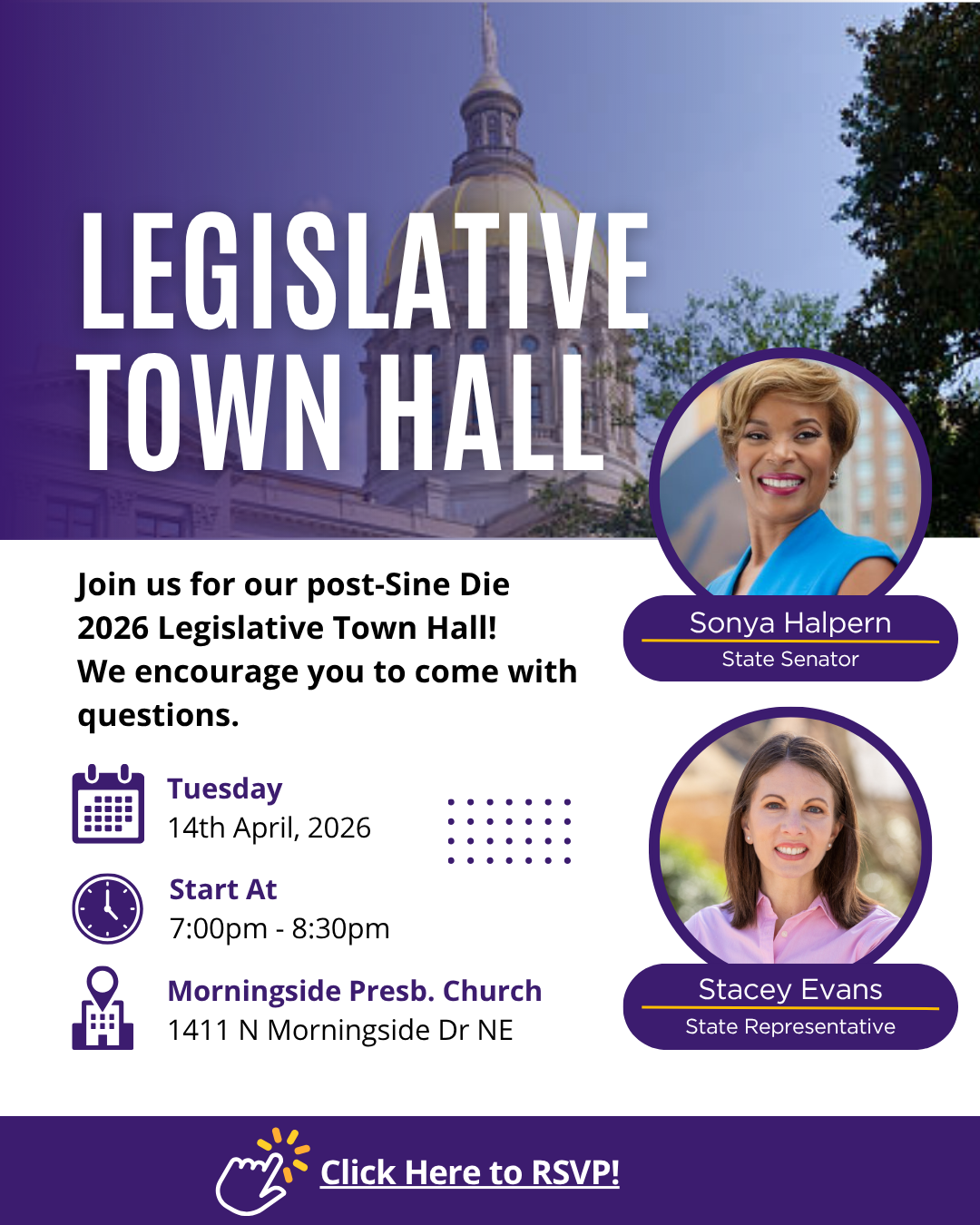
The Sine Die Legislative Town Hall is Tuesday! We will cover what passed, what didn’t, and talk about some of the twists and turns along the way. I hope you will join Sen. Sonya Halpern and me, and please come with questions.
Below is a list of major wins and stops to review in the meantime!
Post Sine Die Legislative Town Hall — TUESDAY!
We will be holding this Town Hall THIS Tuesday, April 14th at 7pm!
We also will be answering questions, so please come with a curious mind! RSVP is not necessary but encouraged so we can anticipate crowd size. RSVP to Elijah Johnson at elijah@staceyevans.com.
Legislative Wins for Georgians
Foster Children (HB 973/FY 26 Amended Budget)
Less than a month before the start of this session, the head of the Department of Family and Child Services (DFCS) told lawmakers that they were in a $85.7 million deficit. The Kemp Administration’s proposed solution was to cut contracts for service providers, and to make those contracts that remained jump through more bureaucratic hurdles. This would have meant fewer visits between children and parents needed for family reunification, less time for aides to spend helping foster parents care for children with complex needs, and juvenile court dates needing to be postponed when children have no transportation to get there.
Instead, both Democratic and Republican Representatives worked to immediately fill in the deficit as part of the Budget. These vulnerable children will now suffer fewer disruptions to their lives.
Property Tax Credits (HB 973, i.e., FY 26 Amended Budget)
The FY 26 amended budget included an additional tax credit for homeowners. Each homeowner will have a $500 reduction in their property bills.
This bill creates a one-time non-refundable income tax rebate of up to $250 for single filers or up to $500 for married couples filing jointly.
Georgia children are falling behind. According to the Nation’s Report Card, only 30% of Georgia fourth graders are reading at a proficient level or above. And per the Georgia Department of Education’s own metrics, 35% of third graders and 43% of fourth graders read below grade level in the 2024-2025 school year.
One strategy that has been successful in other states are literacy coaches in early grades to help teachers. To replicate that here, this bill will require at least one literacy coach in every school offering K-3 classes.
Unfortunately, this bill mandates the literacy coaches while leaving funding up to local school systems unless appropriated by the state. In this year’s budget, only $70 million was appropriated, meaning approximately $10,000 per school. We look forward to building on this progress by finding a more consistent funding stream like the QBE (Quality Basic Education).
Suspension of the Gas Tax (HB 1199)
On March 9, Rep. Ali went to the House well and called on Governor Kemp to cut prices for hardworking Georgians. Less than 10 days later, on March 18, it was part of an important bill and passed overwhelmingly out of the House. On March 20, Governor Kemp signed it into law.
Family Justice Centers (HB 1283)
This bill allows non-profits, counties, municipalities, and district attorneys to establish Family Justice Centers. These centers combine law enforcement and victim service providers in a single location to help victims of family violence, sexual assault, human trafficking, and child/elder abuse.
One can easily imagine a partner attempting to escape a violent relationship and being unsure where to go, or a mother of a child abuse victim not knowing whom to report it to, or a trafficking victim from another state/country not having any support without their trafficker. This bill will allow for a one-stop shop to solve all these problems. A single location can receive reports of victims, provide them services, and initiate investigations to ultimately bring the perpetrator to justice. These centers will also allow for easier coordination and better investigations, leading to more closure for victims and justice for their abusers.
Expanded Sexual Assault Kit Retention (HB 1283)
This bill extends the retention period from 1 year to 10 years for sexual assault evidence containing biological material when a victim chooses not to immediately report the assault. In other words, when a sexual assault kit is performed on a victim at a hospital, a clock starts whereby the evidence is destroyed unless the victim chooses to report the assault. This bill will extend that deadline from 1 year to 10 years.
Many women choose to not report sexual assaults immediately (often due to shame or due to the perpetrator being a romantic partner/father to their child). This bill will allow victims more time away from the horror they experienced before they decide whether they want to seek justice. It empowers women.
Bad Bills we Successfully Stopped

DOGE (SB 28) — STOPPED
This bill would have added a tremendous burden on all agency action and lead to more agency capture by business.
It requires detailed economic studies for major rules and lets legislative committees block them, which could slow decisions and make the process more political and less efficient. It also forces new rules to take effect only twice a year and, starting in 2028, makes every rule expire after four years, meaning agencies must review and rewrite about one quarter of all rules every year, adding major bureaucracy and inefficiency. There is no fiscal note, so we do not know the cost, but in a large state with a $37 billion budget and a vast number of rules, this will likely be very expensive and strain agency capacity. As a result, businesses will struggle to plan long term and may have to spend more time and money lobbying, while agencies, lacking staff and resources, will rely more on industry experts, increasing the risk of agency capture.
All things Anti-Trans (SB 30, HB 54, HB 660) — STOPPED
Thankfully, no anti-trans legislation became law this year.
SB 30 would have banned the prescription of puberty blockers to minors for the purpose of gender affirming care. It would also repeal the exception allowing sex reassignment surgery where medically necessary.
HB 660 would have prohibited Georgia State Employees Health Benefits Plan (SHBP) from covering any gender-affirming care for both minors and adults. This bill also bans any state-run healthcare facility or state-employed health care provider from providing gender affirming services to transgender patients. In addition, state correctional facilities and their medical staff are barred from providing transition-related care to incarcerated people.
HB 54 did both.
Criminalize Librarians (SB 74) — STOPPED
Currently, any employee of any public library is immune from prosecution for distributing harmful materials to minors. This bill would have stripped that immunity if their governing authority (i.e., school board, board of regents, or county library board of trustees) reviews the material and instructs the employee to remove it.
Troublingly, the Majority defeated an amendment which would have removed homosexuality as prohibited sexual conduct.
Dramatic Election Changes (SB 423, HB 215, HB 397, HB 604, HB 661, HB 1108, HB 1227) — STOPPED
There were a large number of election bills that were proposed by Republicans. Nearly all of which would have created a dramatic change to the operation of our elections with less than a year to prepare, and most of which would have actively harmed those same operations. For example, many would have required the state to leave ERIC, an effective and bipartisan multistate voter list maintenance system. Others would have banned early voting. Others still would have required a hand recount on very little showing by an election denier.
Audits have repeatedly shown that our elections are fair with the current technology and processes, so these are clearly attempts to discredit elections in the wake of the Big Lie of 2020 and/or allow for judicial challenges in the event of a Democratic victory in 2026. In the middle of session, the Trump Administration conducted an FBI raid of the Fulton County elections office further exemplifying the need to protect and safeguard our elections, as Georgia continues to be targeted by this current administration. Despite the chaos, representatives of our Fulton County delegation led the charge in calling out this unprecedented federal overreach and tirelessly advocated for legislation that would maintain and uphold the integrity of elections in our state.
The singular exception was SB 214, as passed House committee. In an earlier session, Republicans passed a bill required that we not use QR codes starting with the 2026 general election, but they then never appropriated funds for an alternative. Given no alternative, the Secretary of State has authorized their continued use. SB 214, while not perfect, would have prevented any litigation about this decision by pushing back the requirement to 2028. It is the only bill to receive bipartisan support in either chamber, but Lt. Gov. Jones refused to allow it to receive a vote in the Senate on sine die.
So, we are in the awkward position where we can celebrate not harming our election systems but also remain in a legal gray area because we did not solve the problem made by Republicans years ago.
Streamline Hotel Evictions (SB 463, HB 61, HB 183) — STOPPED
These bills would have stripped basic housing protections from thousands of vulnerable families living in extended stay motels. They would have allowed people to be removed within five days with no notice or court process, based only on a motel agent’s affidavit, and would have overturned a Georgia Supreme Court decision that recognized some long-term residents as tenants with rights. In a state where tens of thousands of families, including over 9,000 school-aged children, rely on extended stay motels as their primary home, this change would have sharply increased the risk of sudden homelessness and disrupted children’s education and stability. By treating long-term residents worse than even recent anti-squatting laws, these bills would have removed due process and created a system where families could be evicted quickly with little oversight or accountability.
Expanded Gun Silencers (SB 499, HB 1324) — STOPPED
These bills would make it easier to own gun silencers in Georgia and reduce important safety protections. While federal law would still require registration and background checks, removing silencers from the state’s list of dangerous weapons weakens oversight and sends the wrong signal about their risks. Supporters say silencers protect hearing, but basic ear protection already does that, and silencers only reduce noise slightly, leaving gunshots still dangerous. At the same time, evidence shows silencers have been used in serious crimes, and making them easier to access could make shootings harder to detect, slow emergency response, and make it more difficult for law enforcement to investigate and prosecute violent acts.
An Everytown analysis found that silencers have been used in over 100 violent incidents and planned attacks, and over 400 federal cases involving serious crimes.
Make Self-Defense Unworkable (SB 572, HB 1226) — STOPPED
These bills would have significantly weakened self-defense laws while placing a heavy burden on the court system. It created a presumption that any use of force is reasonable, shifted the burden of proof from the defendant to the State, and allowed every case involving force to trigger a full pre-trial hearing, which would strain courts, prosecutors, and law enforcement with time-consuming proceedings.
At the same time, the bills removed the ability to claim reasonable force when responding to law enforcement, without giving judges clear standards to evaluate whether the officer’s actions were appropriate. As a result, someone could face criminal charges for protecting themselves during an excessive or unjustified use of force by an officer, raising serious concerns about fairness and accountability.
All things Anti-Abortion (HB 122, HB 441) — STOPPED
HB 122 would have defined life from the moment of conception and would expand anti-abortion measures to any action that would prevent pregnancy after conception, including the morning after pill. No other state has banned emergency contraception and this bill provides no exceptions when it comes to the health of the mother or fetus.
HB 441 would have defined any fertilized egg as a human being in the criminal code, meaning the morning after pill would be murder. Any healthcare provided to the mother that results in the loss of the fetus would be negligent homicide unless “to save the life of a mother.”
Protect PFAS Dumpers (HB 211) and Penalize Victims (HB 1212) — STOPPED
HB 211 would have made it so companies who use PFAS chemicals would be shielded from liability from their use, possession, or most importantly, disposal. Meaning, if a North Georgia carpet manufacturer negligently, or even knowingly, dumps PFAS into the water and thereby harms the surrounding animals, plants, and people, the victims could not be compensated in civil court.
Attacks on PFAS victims did not end there. HB 1212 would have imposed a 50% excise tax on settlement proceeds received by landowners for PFAS contamination.
Limit Longshoremen Worker's Comp (HB 574) — STOPPED
This bill would have taken away a key safety net for injured longshore workers and leave them without timely support. Today, workers can file claims under both federal and state systems, which helps ensure they receive benefits if one claim is denied and allows faster access to care. Federal claims often take two to six years to approve, while state workers’ compensation provides immediate medical care and wage support to help workers recover and return to work. Without state coverage, injured workers could go years without treatment or income and may be forced to rely on public assistance, even though there is no evidence they are abusing the system by receiving double benefits.
Eliminate Securities Enforcement (HB 934) — STOPPED
This bill would have moved securities regulation from the Secretary of State to the Department of Banks and Finance. This is an attempt to punish securities regulators for investigating a Ponzi scheme which benefitted large Republican donors. Even if it weren’t, we cannot afford to weaken our securities regulation.
Correction from Last Week
Attack on Cities/Counties: Immigration and Homelessness (HB 295)
**Note I originally wrote about this bill in last week’s newsletter as having not passed both chambers. It actually did and this bill awaits the Governor’s signature.**
This legislation strips sovereign immunity for local officials when they (1) enact sanctuary city policies, or (2) “decline to enforce” laws relating to homelessness (loitering, shoplifting, etc).
The bill will weaken local control and budgetary decisions. Cities and counties would lose the ability to set policies that best fit their communities. This bill requires locals to maximize policing nuisance crimes, and in a world with limited resources, that means fewer resources for violent crime or non-law enforcement uses like schools and parks.
This bill does nothing to solve underlying problems and simply increases the criminalization of homelessness.
Finally, this bill exposes local officials to lawsuits for doing their jobs. Stripping sovereign immunity means that sheriffs, patrol officers, and city workers could be personally sued for policy decisions. This could discourage qualified people from public service and create costly legal battles.
Want to Read More?
Please check out the Atlanta Journal Constitution's bill tracker if there is a specific issue you are interested in. The link for that tracker is below.
✒️ The AJC's Bill Tracker here!
Again, I look forward to seeing you at the final legislative town hall for this session. Thank you for the privilege of representing your voices under the Gold Dome. Let's continue the good work.
In service,
Stacey Evans